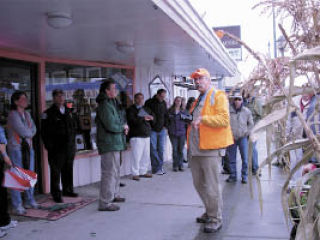
MARYSVILLE — A walk through town near the end of October proved educational for many members of the Marysville community.
The city of Marysville and the Marysville Healthy Communities Project hosted a walkability audit Oct. 30, conducted by nationally-recognized walking expert Dan Burden so that he could size up how walkable Marysville is, and weight in on how it can be changed to make it more pedestrian-friendly.
City of Marysville Community Development Director Gloria Hirashima, a Marysville Healthy Communities Project co-chair whose group is looking at ways of creating a more active urban environment, was wearing both hats Oct. 30, as she joined fellow city staff and Healthy Communities members, as well as elected officials and members of the general public, on a guided walk to various locations around Marysville, starting in Comeford Park.
“The gist of what he told us was that we need to be really careful to make sure our streets are both safe and attractive to pedestrians and bicyclists,” Hirashima said. “Land use and transportation need to come together to create a vibrant community with an emphasis on livability. We can’t just look at streets as ways of moving cars. We need to look at what they bring to the community, as well.”
Among the suggestions offered by Burden, a nationally-acclaimed pedestrian, bicycle, traffic-calming and livable communities expert, was one that Hirashima saw as killing two birds with one stone. Hirashima explained that downtown business owners would like to see more storefront parking, while Burden encouraged city policy-makers and engineers to implement measures to slow down downtown traffic, so Burden’s proposed solution was to create more parking spaces by narrowing the street lanes.
“By narrowing the lanes, we could reduce the speed and encourage motorists to be more careful,” Hirashima said. “The audit encouraged us to look at our streets from the perspective of both local users and outsiders. Cars use the streets, but so do pedestrians, bicyclists and business owners. From the perspective of pedestrians, bicyclists and business owners, do we really want to be just moving tons of cars really quickly through our city? Our challenge is to strive for balance, to make our streets safe and inviting to all users.”
While these are more short-term solutions, the audit also took note measures that could be taken in the longer run, by considering several intersections and other points in the city street grid where traffic tends to jam up. Instead of advocating wider lanes in those areas, Burden favored changing the flow of traffic so that it wouldn’t get congested in a smaller number of overused “choke points.”
“He presented roundabouts as one way of helping traffic move more efficiently,” Hirashima said. “We also identified a number of roads that don’t don’t go through all the way, which increase the loads on the roads that do. If that traffic was more evenly distributed, we wouldn’t need to widen the streets.”
A priority of the Marysville Healthy Communities Project is to emphasize the importance of using urban planning approaches that promote physical activity, such as adding more bicycle lanes and walking trails. The goal is to plan and fund street improvements, pathways, parks and trails that support walking and biking within and between Marysville neighborhoods, city centers, schools and senior centers.