MARYSVILLE A group dedicated to helping developmentally disabled people is reaching out to the community to increase the awareness of an aging special needs population.
But Quil Ceda Community Services is also providing a vehicle for the disabled to help others and thats the key to understanding the true needs of their special clients.
Quil Ceda Community Services is led by Hazel Venables, the mother of a child with Down Syndrome who is 60 years old. At age 86, Venables said its time to step back from the day-to-day chores of helping people like her daughter Leslie, who has been in some sort of group home or assisted living facility since age eight.
The organization is small and helps about a dozen local people; most live at Quil Ceda Meadows, others at a similar caregiver. The home started in 1976 with a house on Cedar Street, and a decade later they found that the aging residents were too old to handle the stairs, prompting a move to another, one-story facility in town.
Now we are saying there is another need, Venables said during an activity session in the basement of the Unitarian Church in Marysville last week.
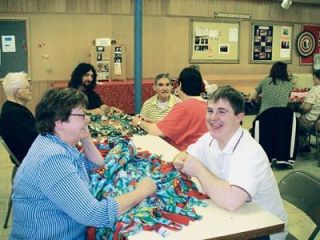
Around the room were a dozen special needs folks, some in their fifties, who were braiding the edges of felt blankets with the help of a caregiver. It would be quick work for anybody else but its not just a chore but an accomplishment for these people. Larry Berg is 52 years old, but his mentally age is probably less than a fifth of that. He greets everyone with a smile and a Pizza man! greeting and has to look closely at what he is doing, tying two strips of felt into a simple braid.
The blankets will be donated to another charity, a point of pride not only for Venables, but for the participants themselves.
This provides them a chance to give back because so often they are on the receiving end, Venables said.
I love it, said Joseph Tennant, a 50-year-old Marysville man with Down Syndrome.
He was braiding the blankets with his sister Becky Kristiansen of Everett, who often cares for him.
Its almost indescribable, the impact, Kristiansen said. They want to do things. They love to do things.
Her brother is living at Quil Ceda Meadows and for the first time in his life is on his own, she said.
He loves it, Kristiansen said.
On my own, I love it, Tennant echoed.
Teresa Bever is the Skagit County coordinator for Project Linus: nationwide group that donates blankets to hospitals, police and fire agencies to give to kids who have been traumatized. She said it was heartening to hear of the efforts at Quil Ceda Community Services.
Its extremely important because without them making these blankets I wouldnt have them to give, Bever said. I really treasure my volunteers.
Giving the special needs community an outlet for their energy is not easy, but it is essential, according to the friends and family members of these developmentally disabled people. It can be a challenge to generate interest among the able-bodied for the needs of the disabled and as some of her charges advance in age it becomes an even tougher sell, Venables lamented.
Sometimes its hard to motivate a community. Its so much easier to work with cute little kids, she said.
But left on their own many of the people with Alzheimers disease or Down Syndrome would just be couch potatoes, since the nature of their condition makes them sedentary and that is often safer than other options, since they need to be watched and cared for.
They are not self-starters. They sit in front of a TV all day, Venables said. We need to provide something.
To that end the group started a new arm at the beginning of July to provide activities for the developmentally disabled population in north Snohomish County. They have lots of volunteers now, but as school starts up many of them will be going back to their studies or the districts where they work. So Venables is looking for a new batch of helpers, as she is 86 years old and has to care for her husband, who has Alzheimers.
She has tentative plans to join forces with one or more local groups that are handling people with similar challenges.
Mville group helps disabled, educates community
MARYSVILLE A group dedicated to helping developmentally disabled people is reaching out to the community to increase the awareness of an aging special needs population.